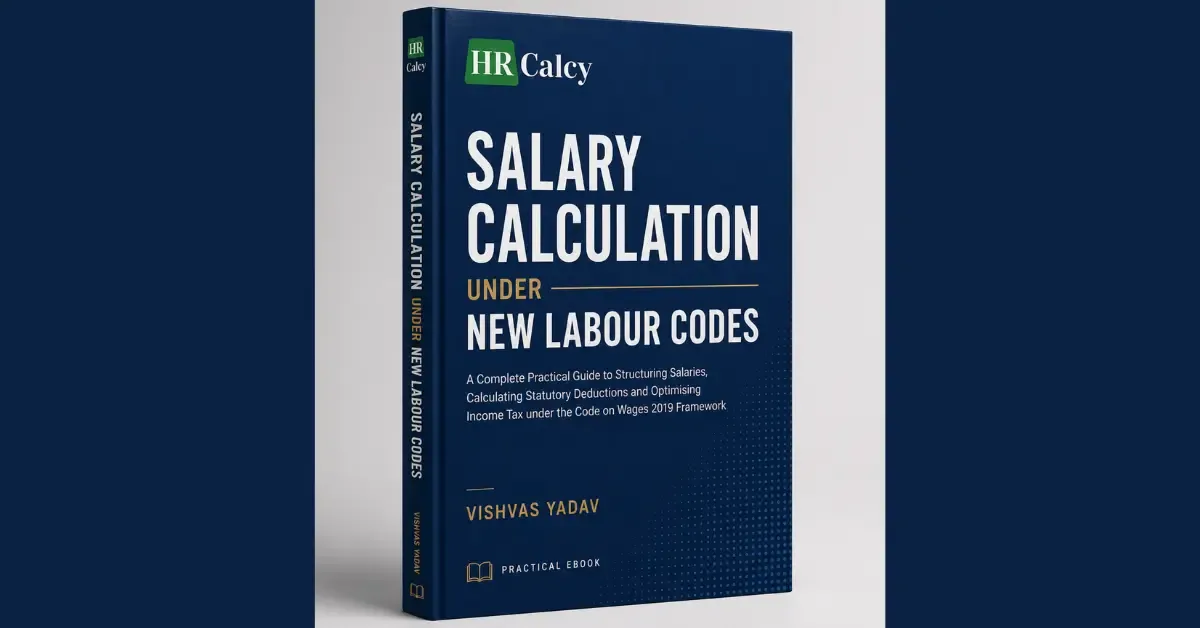
Salary Calculation Under New Labour Codes | Practical eBook
A practical eBook for HR and payroll professionals covering salary structuring, the 50% wage rule, PF, ESI, gratuity, bonus, CTC, net pay and TDS calculations.
You save ₹180
🔒 Secure payment via Razorpay · Instant digital delivery
- 🔒 Secure Razorpay checkout
- ✅ Instant download after payment
- 📧 Download link also sent to email
- ⬇️ 72-hour · 3 downloads link validity
What's Inside
- 15 Chapters
- Step-by-Step Salary Structuring
- ₹30,000 Total Remuneration Worked Example
- ₹40,000 CTC Practical Salary Breakup
- ₹25 Lakh CTC TDS Optimisation Example
- Definition of Wages under New Labour Codes
- 50% Wage Rule and Exclusions
- Minimum Wage Compliance
- Full Wages and Disguised Wages
- In-Kind Remuneration and Reimbursements
- PF, EPF, EPS and EDLI Calculations
- ESI, Gratuity and Bonus Calculations
- Leave Encashment and Overtime
- Net Pay and CTC Calculation
- CTC vs Total Remuneration Structuring
- Income Tax Optimisation
- HRA, LTA, Meal Benefits, NPS and Perquisites
- Tax Optimisation Documentation
- Practical Salary Calculation Examples
About This Product
Salary Calculation Under New Labour Codes
A Practical Guide to Structuring Salaries, Calculating Statutory Components and Understanding TDS
Second Edition
Salary calculation has become more complicated with the new labour code framework. The biggest challenge is not simply knowing salary components, but understanding which components form part of wages, how the 50% rule affects salary structures, how statutory deductions are calculated, and how the final CTC and take-home salary are derived.
This practical eBook explains salary calculation in a calculation-first and step-by-step manner.
Instead of discussing salary concepts only theoretically, the book takes you through actual salary structures and worked examples covering Total Remuneration, Gross Salary, Net Pay, CTC, statutory deductions and TDS.
What You Will Learn
1. Salary Fundamentals
Understand the difference between Total Remuneration, Gross Salary, Net Pay and Cost to Company (CTC), and how these numbers connect with each other.
2. Minimum Wages
Understand how minimum wage compliance works and why the applicable wage base is important when structuring salaries.
3. Definition of Wages
Understand the concept of wages under the new labour code framework and why the wage definition matters for statutory calculations.
4. Exclusions and the 50% Rule
Understand the treatment of exclusions, the 50% rule and how the rule affects salary structuring.
5. Full Wages and Disguised Wages
Learn why simply giving a component the name of an allowance does not automatically change its legal character, and how disguised wages can create compliance issues.
6. In-Kind Remuneration and Reimbursements
Understand the difference between wages, in-kind remuneration and reimbursements, including the treatment of in-kind components.
7. Step-by-Step Salary Structure
Build a salary structure from scratch using a practical ₹30,000 Total Remuneration example, including wage determination, minimum wage checks, exclusions, in-kind components and gross salary.
8. PF Calculation
Understand EPF, EPS, EDLI and employer-side PF components with practical calculations and PF ceiling scenarios.
9. ESI, Gratuity, Bonus, Leave and Overtime
Learn how major statutory components are calculated and understand the common calculation issues associated with each.
10. TDS on Salary
Understand monthly TDS calculation through practical examples based on FY 2025-26 income-tax provisions.
11. Net Pay and CTC
Bring all salary components together to calculate employee deductions, take-home salary, employer contributions, monthly CTC and annual CTC.
12. Complete Practical Salary Breakup
Work through a complete ₹40,000 CTC salary structure, including PF ceiling and non-ceiling comparison, ESI and bonus treatment.
13. CTC-Based vs Total Remuneration-Based Structuring
Understand two approaches to salary structuring and why the 50% rule should not simply be applied to CTC.
14. Income Tax Optimisation
Understand how salary components such as HRA, LTA, meal benefits, NPS, books, periodicals and perquisites can be considered within a compliant salary structure, along with applicable documentation requirements.
15. ₹25 Lakh CTC TDS Optimisation
A detailed practical example showing how salary structure and tax-regime selection can affect TDS and employee take-home pay, with supporting documentation and FBP considerations.
Practical Examples Included
₹30,000 Total Remuneration salary structure
₹40,000 CTC salary breakup
PF ceiling vs non-ceiling comparison
ESI calculation
Gratuity calculation
Bonus calculation
Employee deductions and net pay
Employer contribution and CTC calculation
₹25 lakh CTC TDS optimisation example
Who Is This eBook For?
HR Professionals
Payroll Professionals
HR Generalists
Payroll Executives
Compensation & Benefits Professionals
HR Managers
Payroll Managers
Recruiters involved in salary discussions
HR Consultants
Small Business Owners
Employers and managers involved in salary structuring
Students and professionals learning Indian payroll and salary calculation
What Makes This Book Practical?
The book follows the actual flow of salary calculation rather than explaining each component in isolation.
The examples connect Total Remuneration, wages, statutory components, deductions, gross salary, net pay and CTC.
It also provides practical guidance on documentation and salary structuring for tax optimisation.
Important Edition Note
This is the Second Edition of the eBook.
The income-tax examples and provisions in this edition are based on FY 2025-26. Tax rates, thresholds, exemptions and statutory requirements can change, so current government notifications and applicable rules should always be verified before using any calculation for live payroll.
Disclaimer
This eBook is intended for educational and reference purposes. It is not legal, tax or professional advice. Salary calculation, labour-law requirements, statutory rates, thresholds and income-tax provisions may change. Readers should verify the applicable provisions and current government notifications before making payroll, salary-structuring or tax decisions.