Salary Breakup Calculator | New Labour Codes
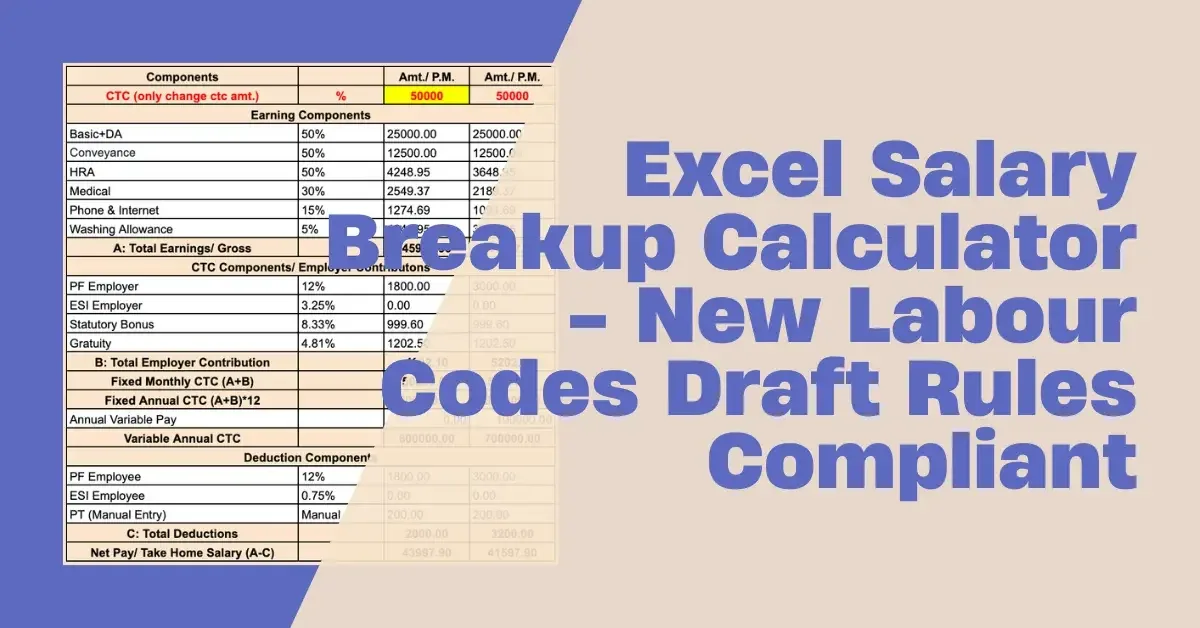
Excel salary breakup calculator based on the New Labour Code wage framework, covering 50% wages, PF, ESI, bonus, gratuity, deductions, Net Pay, minimum wages and CTC.
You save ₹50
🔒 Secure payment via Razorpay · Instant digital delivery
- 🔒 Secure Razorpay checkout
- ✅ Instant download after payment
- 📧 Download link also sent to email
- ⬇️ 72-hour · 3 downloads link validity
What's Inside
- Build a Salary Structure from CTC - Start with the required CTC and work through the salary structure to understand how wages, allowances, employer contributions and employee deductions affect the final breakup.
- Apply the 50% Wage Approach - Structure Basic + DA around the New Labour Code wage framework and understand how the 50% approach affects salary components.
- The important point here is that the 50% concept should not be marketed as “50% of CTC.” The supporting material specifically distinguishes Total Remuneration from CTC.
- Check Minimum Wage While Structuring Salary - Enter the applicable minimum wage and use it as part of the salary-structure calculation. The workbook material uses Karnataka ₹14,000 as an example and specifically says the applicable state rate should be checked.
- Calculate PF with Ceiling or on Actual Wages - Compare PF calculation using the PF ceiling scenario and the No PF Ceiling scenario to understand the resulting employer contribution, employee deduction and CTC impact.
- The underlying salary example explicitly presents both PF scenarios side by side.
- Calculate Complete Employer Cost - Include employer-side contributions such as: Employer PF, Employer ESI, Statutory Bonus, Gratuity, Total Employer Contribution, Calculate Employee Take-Home Pay
- Calculate: Employee PF, Employee ESI, Professional Tax, Total Deductions, Net Pay
- Move from Salary Components to Complete CTC - See how salary components and employer contributions come together to determine the overall Monthly CTC and Annual CTC.
- Useful for Real Salary Structuring - Designed for HR, payroll and C&B professionals who need to create, review or explain salary structures rather than calculate individual components manually.
About This Product
Creating a salary breakup is no longer simply a matter of deciding Basic, HRA and allowances.
When you structure salary, the relationship between wages, allowances, PF, ESI, bonus, gratuity, minimum wages, employee deductions and CTC can significantly affect both employee take-home pay and employer cost.
The Salary Breakup Calculator | New Labour Codes is an Excel-based tool designed to help HR and payroll professionals build and analyse a salary structure using the wage framework reflected in the New Labour Codes.
Build the Salary Structure Step by Step
The calculator helps you work through the salary structure from the starting CTC or remuneration figure to the resulting employee Net Pay and employer cost.
The calculation flow covers:
CTC / Total Remuneration → Wages → Basic + DA → HRA & Allowances → Gross Salary → Employer Contributions → Employee Deductions → Net Pay → CTC
This makes it easier to understand how changing one component can affect the overall salary structure.
Work with the 50% Wage Approach
A key part of the New Labour Code salary-structuring framework is the definition of wages and the treatment of excluded allowances.
The calculator is designed around the 50% wage approach, helping you structure Basic + DA and understand the effect of allowances on the wage base.
Importantly, the 50% calculation should not simply be treated as 50% of CTC. Employer-only costs such as employer contributions form part of CTC but are not the employee's Total Remuneration.
Check Minimum Wage
The calculator includes a minimum wage input/reference so you can consider the applicable minimum wage while designing the salary structure.
The workbook uses Karnataka ₹14,000 as an example. This is only an example value and should be replaced with the applicable minimum wage for the relevant state, category and employment.
Calculate Employer Contributions
The calculator incorporates employer-side components such as:
-
Employer PF
-
Employer ESI
-
Statutory Bonus
-
Gratuity
-
Total Employer Contribution
This allows you to understand the employer's actual cost instead of looking only at the employee's gross salary.
Calculate Employee Deductions & Net Pay
The calculator also takes employee-side deductions into account, including:
-
Employee PF
-
Employee ESI
-
Professional Tax
-
Total Deductions
-
Net Pay
This helps you see the relationship between the salary structure and the employee's expected take-home pay.
Compare PF Ceiling Scenarios
The salary-structuring material provides both:
PF Ceiling
and
No PF Ceiling
scenarios.
This helps HR and payroll professionals understand how PF treatment can change the resulting employer contribution, employee deduction and overall CTC.
Calculate Monthly & Annual CTC
Once the salary structure is built, the calculator helps determine:
-
Monthly CTC
-
Fixed Annual CTC
-
Variable Annual CTC
-
Overall Annual CTC
Who Should Use This?
This calculator is useful for:
-
HR Professionals
-
Payroll Professionals
-
HR Executives
-
Payroll Executives
-
HR Managers
-
Payroll Managers
-
Compensation & Benefits Professionals
-
HR Consultants
-
Payroll Consultants
-
Business Owners
-
Employers
-
SMEs
Common Use Cases
Use the calculator when you need to:
-
Create a new salary structure
-
Break CTC into salary components
-
Structure salary using the 50% wage approach
-
Review an existing salary breakup
-
Compare PF ceiling and No PF Ceiling scenarios
-
Estimate employer contribution
-
Calculate employee deductions
-
Estimate Net Pay
-
Check salary against a minimum wage reference
-
Calculate Monthly and Annual CTC
-
Explain salary breakup to employees or management
-
Support salary restructuring and compensation discussions
What You Receive
You receive an Excel-based Salary Breakup Calculator designed for salary structuring and calculation.
It is not payroll software and does not directly connect to EPFO, ESIC, banks or government portals.
The calculator should be used with the applicable employee details, state-specific requirements and current statutory provisions. Example values should be replaced with the applicable figures before using the calculation for actual payroll or salary structuring decisions.